
The lockdown drill starts at 11.05am. Within seconds, every phone in the front office lights up. In the gym, a PE class keeps playing because nobody hears a thing. The art room has no handset, and the grounds staff on the oval only find out when a teacher waves at them. Afterwards, nobody can say which part failed: the phones, the PA or the network. A school lockdown alert system in Australia only works when all three layers fire from one trigger and reach every zone. Here is how that works in practice.
Most schools did not buy their emergency communications as a system. The PA and bells came from an AV contractor when the building opened. The phones came from a different vendor a decade later. The Wi-Fi and switches were added by the IT team as budgets allowed. Each part works on its own, and each part gets tested on its own. The gaps show up during a drill. The alert reaches every desk phone but not the hall, the library, the canteen or the workshops. Outdoor areas such as ovals, courts and car parks rely on someone running out to tell people. Rooms with no handset never hear it at all. Students who are deaf or hard of hearing may miss an audio-only alert entirely, and a single network fault can take the whole lot offline. When something fails, the phone vendor points to the network, the network provider points to the PA, and the PA contractor is no longer on contract. The school is left with a gap in its safety plan and no single party accountable for closing it.
A reliable lockdown alert has three layers that are designed together and triggered together.
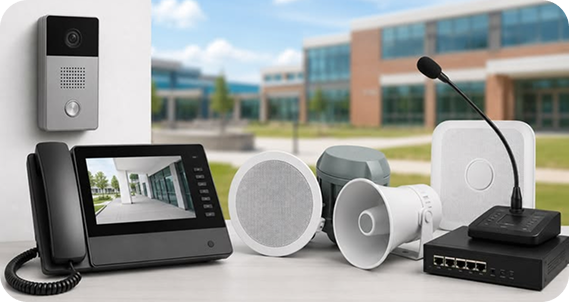
Layer 1: Mitel mass notification to every handset and softphone Mitel Revolution is Mitel's mass notification platform. It works with MiVoice Business and pushes a lockdown alert to every desk phone, softphone and staff mobile app at once, with text on the screen and an audio message through the handset speaker. Mitel says Revolution supports more than 22,000 endpoints, so it scales from a single primary school to a multi-campus college. Revolution also tracks delivery and confirmation, so after a drill you can see which devices received the alert. It connects to IP and analogue paging systems and to third-party systems through standard integrations, which is what lets it trigger the PA layer.
Layer 2: Algo audio and strobe alerts in every zone Phones only cover rooms that have phones. Algo IP paging and alerts fill the rest of the campus. Algo IP speakers go into halls, corridors, libraries and canteens. Outdoor horn speakers cover ovals, courts and car parks. Algo strobing lights flash in workshops, music rooms and gyms where noise drowns out audio, and they give a visual alert for students and staff who are deaf or hard of hearing. Because Algo runs over the school's IP network, each device can be addressed as its own zone. A lockdown can play a distinct tone and a pre-recorded message that sounds different from the evacuation alert, so nobody confuses the two. Algo devices also report faults, so a speaker that has dropped off the network shows up before the next drill, not during it.
Layer 3: A Fortinet network that stays up When phones, speakers and strobes all run over IP, the network is the backbone of the safety plan. A FortiGate firewall with a backup 4G or 5G link keeps off-site alerts and remote triggers working if the main internet service drops. Inside the school, the alert devices sit on their own segment. That segmentation matters. With FortiNAC controlling what connects where, the PA and phone system cannot be reached from student or guest Wi-Fi. A student cannot browse to a speaker's web page or play their own message over the PA. Our network security solutions page covers the full Fortinet approach.
The goal is a single action that starts everything. In a typical eComms design, the sequence looks like this:
1. A staff member presses the lockdown key on a desk phone, taps the mobile app or hits a panic button.
2. Mitel Revolution sends the lockdown message to every handset, softphone and staff mobile on the system.
3. The same event triggers the Algo zones. Speakers play the lockdown tone and recorded instruction, and strobes flash in noisy and outdoor areas.
4. The Fortinet network carries the traffic on its own protected segment, with a failover link if the primary service is down.
5. After the drill, the reports show which devices received the alert and which speakers or strobes were offline, so the debrief is based on data rather than memory.
The all-clear follows the same path, so staff get one consistent signal to end the lockdown.
eComms designs, installs and supports all three layers as one system. We are an authorised Algo integrator, we deliver Mitel phone systems, and we build Fortinet networks for schools, so one team is accountable for the whole alert path. Our Melbourne-based team delivers nationally, from single primary schools to multi-campus Catholic and independent colleges. Every project starts with a site walk. We map your buildings and outdoor areas into zones, check which rooms lack phones, test your network for PoE capacity and failover, and confirm what can be reused. See our school communications technology page for the full education stack.
Book a free school site assessment
A lockdown alert is only as strong as the zone it fails to reach. When phones, PA and network are designed and supported by one team, every room, hall and oval gets the same message at the same time, and you have the reports to prove it. Talk to our team and book a free site assessment for your school.